
Monroe City Directory Runs and Access
Monroe city directories survive in a patchwork of local, statewide, cataloged, and digital routes. The clearest starting point is the 1860 Monroe directory linked through the Genealogical Society of Monroe County, followed by an 1861–62 regional gazetteer and selected later years documented in established collections. A directory is a dated snapshot, not a complete roll of every person in town. Check the edition, the format, and the page image before treating an entry as evidence.
| Directory collection | Known years | Where held | How to reach it |
|---|---|---|---|
| Monroe city directory | 1860 | GSMC-linked resource | PDF/download route; inspect the page image before quoting an entry |
| Lake Shore Gazetteer and Business Directory | 1861–62 | Established archival and catalog routes | Regional context, not a complete modern-style household roll |
| Cataloged Monroe directories | 1916; 1946, 1948, 1950, 1952–54, 1956, 1958–60 | MCLS, Library of Michigan, and directory collections | Confirm the exact volume, shelf, microfilm, or licensed route with staff |
| Library directory routes | Varies by title | Library of Michigan print, rare-book, and microfilm holdings | Second-floor south shelves or Microfilm Room; licensed databases may be library access |
No complete Monroe reverse-directory run, a final printed-year boundary, or public item links for every cataloged volume were verified. An absence from one shelf or online catalog does not settle whether another format exists.
Note: Write down the title, edition year, page, and format before comparing a name across Monroe city directories.
Monroe City Directories at Ellis Library
The Genealogy Collection at Ellis Library & Reference Center is the practical local fallback for Monroe directory work. It is on the second floor, with stairs and elevator access, and its reference center closes 15 minutes before the library. The collection reaches beyond directory volumes into census transcriptions, probate and land material, plat maps, newspapers, church and cemetery records, oral histories, and family histories. MCLS also identifies city directories, digital collections, and the Custer Collection through its broader research route.
Ask the reference desk for a title by place and year, then ask whether the result is print, microfilm, electronic, or a library-access database. Ancestry Plus, FamilySearch, LaFrance, and Seeking Michigan are named library resources, but the available access method can vary. The library’s research contact is the Mary K. Daume Service Center at 840 S. Roessler Street, Monroe, MI 48161, 734-241-5770.
For collection routes and companion materials, use the MCLS genealogy collection and its research overview. Bring spelling variants, a street address, and a target year so staff can distinguish a directory question from a general surname search.
GSMC Sources Around Monroe Directories
The Genealogical Society of Monroe County supplies the wider context that makes a thin directory line useful. Its research materials point to directories, maps, atlases, newspapers, church records, yearbooks, cemetery work, and family collections. The Betty Gay Collection has more than 5,000 names in 35 binders, and GSMC describes a cemetery index with more than 95,100 Monroe County burials. Those are leads to test against a dated directory entry, not substitutes for the volume itself.
The GSMC research links show the local routes for these supporting collections.
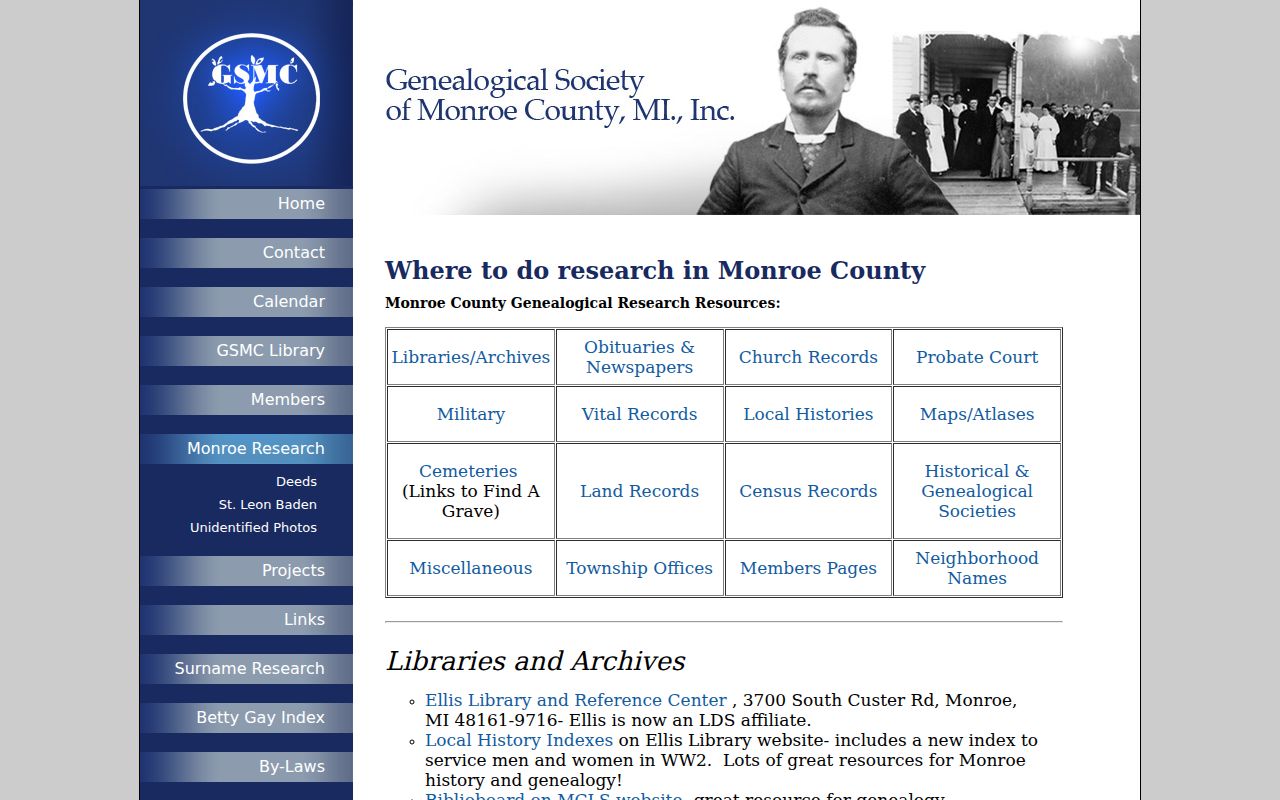
The society says its archive is closed until further notice because of construction, while members provide Wednesday-morning help at Ellis Library. Check the current notice before making a trip. Its catalog can still help identify a relevant title or subject.
Note: A directory address gains value when a newspaper, cemetery, church, or atlas record independently matches the household and date.
Reading a Monroe City Directory Entry
City directories commonly organize people by surname, and Polk-style books may also be searched by street name or phone number. Street pages are usually alphabetical by street and then arranged by house number. The actual 1860 Monroe PDF was not visually inspected during research, so no Monroe entry should be reconstructed or quoted here. Treat the fields below as an inspection inventory, then use the publisher’s own page image and abbreviation key to determine what that edition actually means.
| Name line | Record surname, given name, initials, spelling, and any relatives shown with the entry. |
|---|---|
| Street line | Capture the house number, street, ward, cross-street, or business location exactly as printed. |
| Occupation or business | Transcribe the printed trade, employer, business name, proprietor, or partner label without modernizing it. |
| Household notation | Check for spouse, widow or widower, boarder, renter, owner, or other marks only when the volume prints them. |
| Edition evidence | Keep the publisher, edition year, page, catalog or shelf reference, and a note about image legibility. |
- Criss-cross section
- A street-order portion of a directory, used to search an address after a surname search fails. Its exact Monroe year coverage has not been verified.
- Householder index
- A name arrangement centered on the listed household head. It may omit other people who were at the address.
- Abbreviation key
- The publisher’s legend for shortened words and marks. Find and preserve it before interpreting an occupation or household label.
Monroe City Directory Dates and Custody
Monroe’s historical record trail has several custodians. The city was incorporated as a village in 1817 and as a city in 1837, while the Monroe County guide lists Deed Books A, B, and C from 1806 through 1818. Directory evidence begins at least with the 1860 Monroe volume. Later cataloged runs establish useful checkpoints, but they do not prove continuous annual publication. The county’s current preservation materials also describe historical books under care, not a finished online archive.
| 1806–1818 | Library of Michigan lists Deed Books A, B, and C, including wills recorded in deed books. |
|---|---|
| 1817 and 1837 | Monroe’s village and city incorporation dates help date local institutional context. |
| 1860 | A GSMC-linked Monroe city directory supplies the earliest verified local directory point. |
| 1861–62 | The regional Lake Shore Gazetteer and Business Directory offers a nearby chronological companion. |
| 1916 and 1946–1960 selections | Established collections catalog selected Monroe runs; the exact public item link is not known for each volume. |
Layered custody is the important lesson. A catalog entry, an index, a scan, and a certified record are different forms of access, and each needs its own citation.
Trace Monroe City Directories by Household
Use annual or selected editions to build a household sequence, then bridge the larger gaps with federal census records. A directory may list an owner, a business address, a mailing address, or only a household head. It does not prove every resident at the address. When a person disappears, test a move, death, remarriage, a spelling change, or a business change with a separate local source.
- Start with a known Monroe edition and capture the name, address, occupation, household marks, page, and abbreviation key.
- Move one available edition backward and forward. Search initials, spelling variants, married or maiden names, and widow or widower labels.
- Use a street-order section if the surname route fails, checking both sides of the street and nearby ward descriptions where printed.
- Pair the directory sequence with the appropriate federal census. Recent federal census images remain closed under the 72-year public rule.
- Test major changes with a deed, probate file, obituary, church register, marriage or death index, or city tax roll.
For a present-day address record after the historical trail ends, the Monroe by-street directory explains the current parcel and deed route. Keep that modern owner trail separate from the people who may have occupied an earlier household.
Monroe Newspapers Beside Directories
Newspapers can check a directory’s annual snapshot with births, marriages, deaths, sales, civic notices, school events, church items, and business notices. The digitized archive includes 72,903 pages of the Monroe Evening News for 1918–1945. It also lists titles such as the Monroe Gazette, Monroe Monitor, Monroe Times, Dundee Reporter, and Carleton Messenger across their documented runs. Search the name with address and date variants, then read the scan because OCR can misread personal names.
The digitized Monroe-area newspaper archive is a useful companion to a Monroe city directory entry.
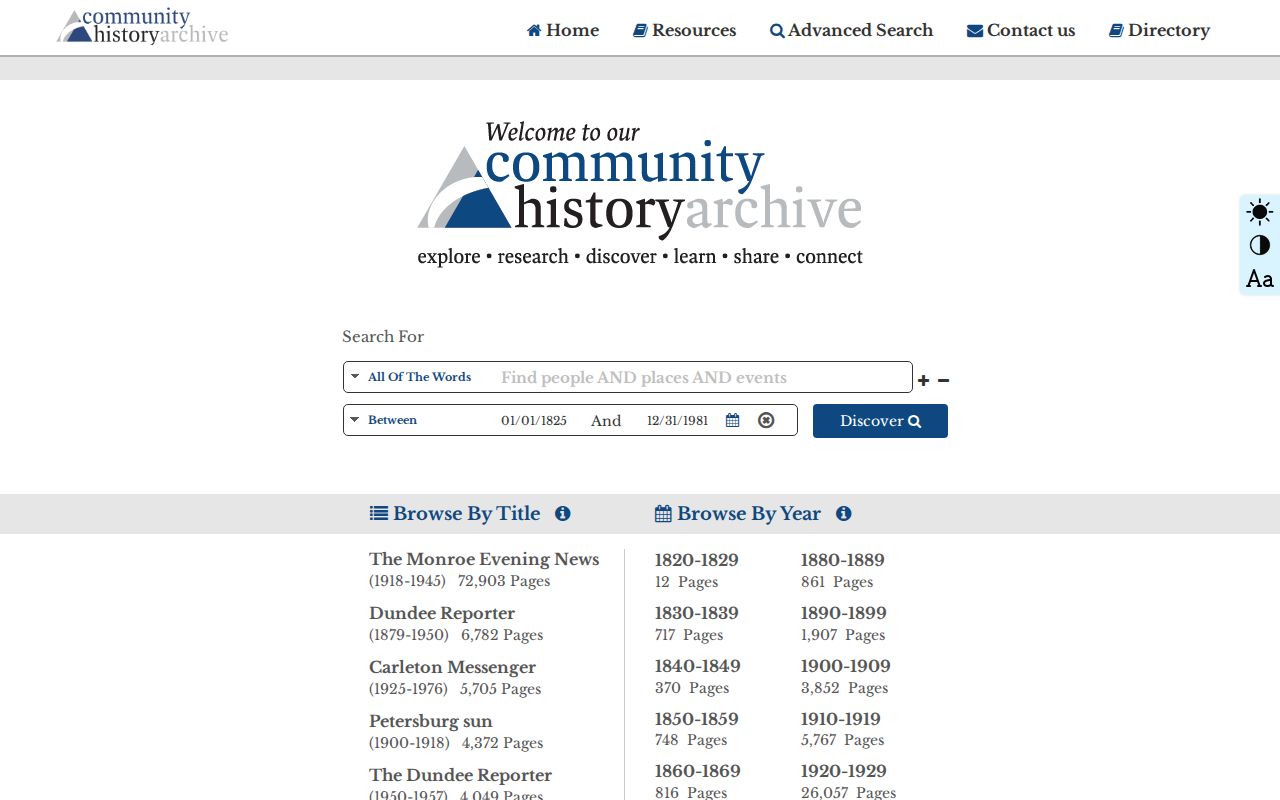
A newspaper hit can confirm a household’s date or relationship, but it still needs comparison with the directory edition, page image, and another record when the identity matters.
Monroe Maps and Arrival Clues
An older Monroe address sometimes needs a map before it can be matched to a directory line. GSMC links a 1870–1920 city ward map, maps from 1859 and 1901, an 1876 atlas, a 1916 state atlas, and a Sanborn route through the Library of Congress. The 1896 atlas is especially useful because it includes a list of residents with their date of arrival. That detail can separate people with the same name and explain when a household entered the county.
Use the Library of Michigan’s Monroe County guide to connect its map and deed-book holdings. Sanborn editions and direct item links still need verification, so do not assume a map exists for every year or address.
Monroe City Directory Access Is Uneven
Not every historical directory is online, and a search result is not automatically an image, a complete run, or a readable entry. Monroe’s sources place some material at Ellis Library, GSMC, the Library of Michigan, Archives of Michigan, and digitized newspaper services. The right next step after a missing online result is often a catalog, microfilm, reading-room, or reference-desk request rather than a broader web search.
GSMC also reports cemetery, church, yearbook, obituary, map, and Civil War materials that can turn an uncertain line into a better documented family-history trail. Their dates and editorial choices differ, so record what each source actually establishes.