
Monroe Resident Lookup Records
A Monroe resident lookup is a comparison of records, not a search of one master list. The public property roll can connect a person to an assessed parcel, while the county map provides the parcel and municipal context. A court index can identify a party and case history. Vital, probate, newspaper, directory, license, and entity records answer different questions and often have their own access rules. Treat a recorded owner, a registered voter, a court party, a licensee, and a directory occupant as distinct roles until the records connect them.
| Record | What It Confirms | Where | Access |
|---|---|---|---|
| Assessor and parcel roll | Assessed owner or taxpayer, parcel, situs, and legal description | Monroe BS&A Online | Basic search is public; it is not an occupant list. |
| Recorded deed index | Grantor, grantee, instrument, recording date, and legal-description trail | Monroe County Fidlar Direct Search | Name index begins in 1981; Laredo describes records from 1976. |
| Voter registration | Registration status and public voter-information fields | Michigan Voter Information Center | Individual route or lawful QVF request; sensitive fields are withheld. |
| Court index | Party role, case number, type, filing, status, and disposition | MiCOURT Case Search | Public informational index; the court controls the file and copies. |
| Vital record path | Life-event facts and relationships | Monroe County genealogy research and MDHHS | Birth access is restricted before the statutory opening period; other rules vary. |
| License or entity filing | Public credential, entity, or registered-agent affiliation | MiPLUS and MiBusiness Registry | Public affiliation records, not proof of a home address. |
Begin with the strongest fact already in hand. An address or parcel number points toward the assessor and deed chain. A possible court matter belongs in MiCOURT and then with the local clerk. An event such as a marriage or death belongs with the county clerk, MDHHS, or historical indexes. For an older household trail, Monroe newspapers, directories, yearbooks, cemetery material, and probate records can add a dated local connection. The Monroe city directories are the better route when the question is where a household appeared in a particular past year.
MiCOURT for Monroe Resident Lookup
MiCOURT has a party-name panel with court selection, last name or business, first name, middle name, and birth year. It also offers a structured case-number panel with year, number, and type. Use an exact name first, then try initials, middle names, married or maiden names, and likely spelling variants. Select the relevant court or location when the screen provides that option. The statewide search is a lead, not the official record, and some criminal information is subject to a seven-year sentence display rule.
| MiCOURT result detail | Why it matters |
|---|---|
| Party name and role | Shows how the matched name appears in the case, rather than proving identity by name alone. |
| Case number and court | Gives the clerk a precise record to locate or explain. |
| Case type or category | Separates unlike matters that may involve the same person. |
| Filing date, status, and disposition | Places the record in time and identifies its procedural state. |
MiCOURT does not display every kind of file. Adoption, juvenile, child-protective, mental-health, name-change, many protective matters, wills, and other protected categories are excluded from public search. A result that seems relevant should be checked with the court, filing date, county, case type, party role, and disposition. Local files may hold pleadings or judgments not seen in an index, while sealed, expunged, family, juvenile, and protected-victim material may be withheld or redacted. Do not infer that a missing result means a person never lived in Monroe or that no record exists.
Sorting Similar Monroe Resident Names
Common-name risk is high in Monroe directories, deeds, court indexes, and newspapers. A sound comparison uses two independent facts before connecting entries. Compare an address with an approximate age or year, a parcel with its legal description, a court matter with its filing date and county, or an obituary with a cemetery or relative record. Keep the date beside each fact. A current assessed owner, an older directory occupant, and a voter record are separate snapshots, not one uninterrupted account.
For a deed trail, the county advises starting with a grantor or grantee name and an approximate year. Staff cannot search ownership by street address. The address-to-name bridge comes from the assessor or GIS viewer, then the legal description and party index help distinguish the correct chain. Along the River Raisin, historic French Claims and private claims may look unlike a simple modern parcel grid. Search the legal description, spouse, estate, trustee, or business name when an exact modern name or street string fails.
Note: A parcel mailing address can identify where tax correspondence is sent, but it can be outside Monroe and does not establish that the owner lives at the parcel.
Verifying a Monroe Resident Record
Use a short verification chain when the goal is to determine whether two records concern the same person. Start by anchoring a name to an address or another local identifier, then make each later step test that match. The assessor can explain parcel-card fields, deed staff can explain a party-name search, and a court clerk can identify the custodian and copy process. Ask for procedure and status, not for restricted personal information.
- Search BS&A Online by name, address, or parcel number. Record the parcel, situs, legal description, sale-history details, and assessment year that are visibly supplied.
- Use name variants in MiCOURT. Compare the court, case number, party role, and filing date with the known Monroe facts.
- For a life-event question, check the appropriate county or state index. A death, marriage, or divorce verification provides limited event facts and is not the same as a certificate.
- Request a certified copy or inspect the local file only when the custodian confirms eligibility and the record is needed to settle the question.
- Docket
- A court's running case record, usually organized by case number and filing events.
- Index and image
- An index points to a record through names, dates, or numbers; an image is the scanned document or a view of the underlying record.
- Certified copy
- A custodian-issued copy that formally attests to the record; eligibility, fee, and contents depend on the record type.
Monroe Vital Record Paths
Vital records can confirm events and relationships, but they require care with access limits. Monroe County genealogy material lists births beginning in 1874, deaths from 1867, and marriages from 1818. MDHHS maintains statewide records for Michigan events. Birth records are restricted before the 100-year public-opening rule in MCL 333.2882, while the Monroe genealogy page describes a 110-year local practice, so confirm county handling before relying on a genealogy exception. Death, marriage, and divorce copy rules are broader, but a court or probate file may still have separate restrictions.
Michigan's vital-record order page shows the statewide request channels and the information a requester must assemble.
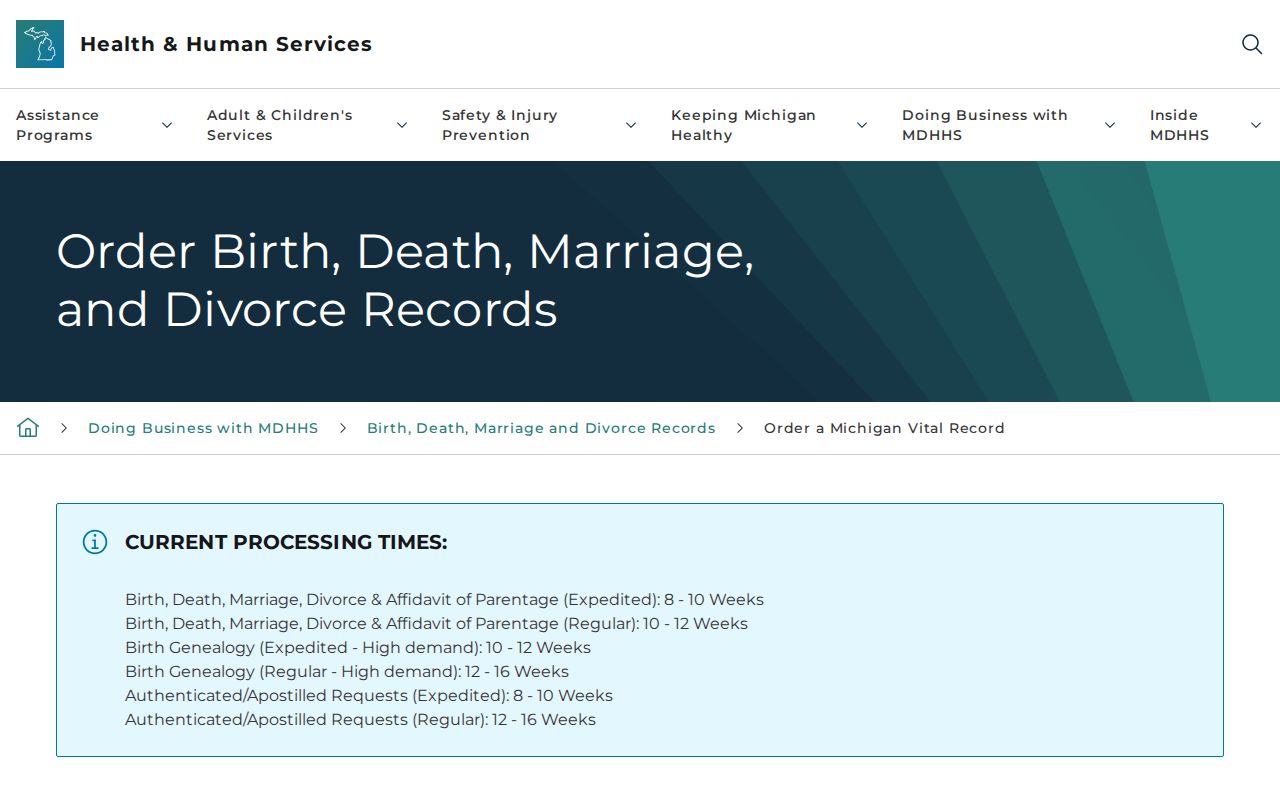
The order screen reinforces a key distinction: a verification gives limited event facts, while a certified copy follows the custodian's eligibility and application process. MDHHS accepts mail, authorized online orders, phone requests, a dropbox, and in-person appointments. Monroe County also has a genealogy counter, and MCLS, the Library of Michigan, Archives of Michigan, GSMC, and newspapers are useful historical channels when a public online image is not available.
Michigan's standard state search fee is listed as $34, with stated processing ranges that vary by request type. Send a signed application, valid identification where required, supporting documents, and the correct fee. The county genealogy research hours listed in the source are Tuesday and Thursday, 9 a.m. to noon and 1 to 4 p.m.; check the county page before a visit. FOIA can seek an existing public administrative record or index, but the vital-record application is the proper route for a certified certificate.
Monroe License and Entity Records
Public business and professional records can help distinguish a person with a common name, especially when a public role, entity, or credential is already known. The MiBusiness Registry reports public entity and registered-agent information. Its registered office can differ from the actual place where a business operates. Michigan UCC records can be searched by debtor name and show financing-statement information, while the LARA MiPLUS search can show a licensee's name, number, profession, status, issue or expiration information, and fields that vary by profession.
These are affiliation records, not a household roster. Preserve the exact legal name, entity or license number, date, role, status, and address type before comparing a result with Monroe court, parcel, newspaper, or vital material. The Monroe County Clerk records business and professional registrations, but a current public county search form and field list were not located. A focused request by name, year, and record type is more useful than asking the clerk for an undefined list of all businesses.
Monroe Resident Record Privacy
Some gaps are deliberate. Michigan's Address Confidentiality Program gives eligible people a designated address and mail-forwarding channel, and that address can appear in voter registration and other public displays. A missing ordinary address may reflect a protected process. Do not try to reconstruct an actual residence from public sources. Voter records also withhold items such as full month and day of birth, driver or state ID numbers, phone, email, digitized signatures, and other sensitive fields.
Court rules protect or exclude information such as dates of birth, Social Security numbers, driver or state ID numbers, passport and financial-account information, and certain victim contact information. DMV personal information is separately restricted by federal law. If a record is wrong, contact the source custodian with the exact parcel, case, license, or record number, the factual error, supporting documentation, and a secure way to respond. The assessor, Register of Deeds, court clerk, MDHHS or county clerk, Bureau of Elections, and licensing agencies each control their own correction process.
Limits on Monroe Resident Lookup
Michigan Freedom of Information Act requests can seek existing public county or city records. The state framework calls for a response within five business days, with a possible written extension of up to ten business days. It does not require a custodian to create a new record or disclose protected fields. When an online index stops, use the clerk or recorder counter, a written FOIA request for a defined existing record, the library's microfilm and catalog, or the state archives. A blank online result is not proof of absence.
Lawful use. Use Monroe resident records for personal, lawful research and stop if a source indicates protection or confidentiality. Repeatedly using records to monitor, threaten, intimidate, or contact someone can violate Michigan anti-stalking and harassment laws.