
Finding Monroe Resident Records
Start with a name, a full address, or a time period. In Monroe, one source may identify a parcel owner while another records a voter, a court party, a directory household head, or a person connected to an estate. Those are useful but different facts. A property card is strongest when an address is known. A date range and a party name work better for deeds. Older households are often easier to place with a city directory, newspaper notice, cemetery index, church record, or probate file.
Check the record date as carefully as the name. A mailing address can differ from the physical parcel. A deed confirms a recorded transaction, not every person who lived there. A current record and a historical entry should be kept as separate points on a timeline. Monroe County, Michigan offices, the City of Monroe, Michigan, state agencies, and local history collections each keep a portion of that trail.
- Use an address, owner name, or parcel number in the local property search to establish the parcel and its current assessment record.
- Use the mapped parcel and legal description to keep the street, municipality, and ZIP context straight.
- Search the deed index by a known grantor or grantee and an approximate year, then compare the legal description.
- For a past household, check dated Monroe directory volumes, newspapers, obituaries, and archival records rather than treating a current roll as history.
- When an item is not online, ask the custodian for the correct counter, copy, genealogy, or Michigan Freedom of Information Act process.
Monroe Resident Records Desks
Three offices provide the most practical starting points for a Monroe resident search. The county Register of Deeds keeps recorded land instruments. The City Assessor and BS&A route connect an address with its parcel record. Election records have a separate Michigan process and redaction rules. Each office can explain the procedure for its own records, but none should be asked to turn a partial record into a complete household list.
Monroe County Clerk/Register of Deeds
51 S Macomb Street
Monroe, MI 48161
734-240-7390
City of Monroe Assessor
120 E First Street, second floor
Monroe, MI 48161
734-384-9170
Monroe Clerk-Treasurer and Elections
120 E First Street
Monroe, MI 48161
734-384-9140
For a whole street or a parcel chain, the Monroe street directory route uses the address first and then moves to the recorded-name trail.
Monroe Parcels Lead to Names
The local BS&A entry point offers Address, Name, and Parcel Number searches, plus detailed record, current tax, delinquent tax, and assessing routes. Search by the identifier that is already reliable. An address can reveal a parcel and assessed owner or taxpayer. A name search is an owner or taxpayer lead, not a search of all occupants. When an old address does not match, the parcel number and legal description are usually more durable keys.
The property card may show the parcel number, owner placement, situs and mailing context, assessed value, state equalized value, taxable value, land and improvement values, zoning, acreage, legal description, sales, grantor, grantee, and Liber/Page. Live cards can differ. A homestead or owner-occupancy classification is tax evidence only. It does not prove day-to-day presence at the property.
| BS&A search field | How Monroe research uses it |
|---|---|
| Address | Enter a street number or full address to locate the property record. |
| Name | Use the owner or taxpayer surname, with a first name as an optional narrowing detail. |
| Parcel Number | Use the local parcel identifier to bridge the mapped property and assessment record. |
| Search scope | Documented BS&A scopes include All Records, Assessing, and Tax; the live Monroe display can vary. |
The Monroe BS&A search shows the address, name, and parcel entry choices used for that first check.
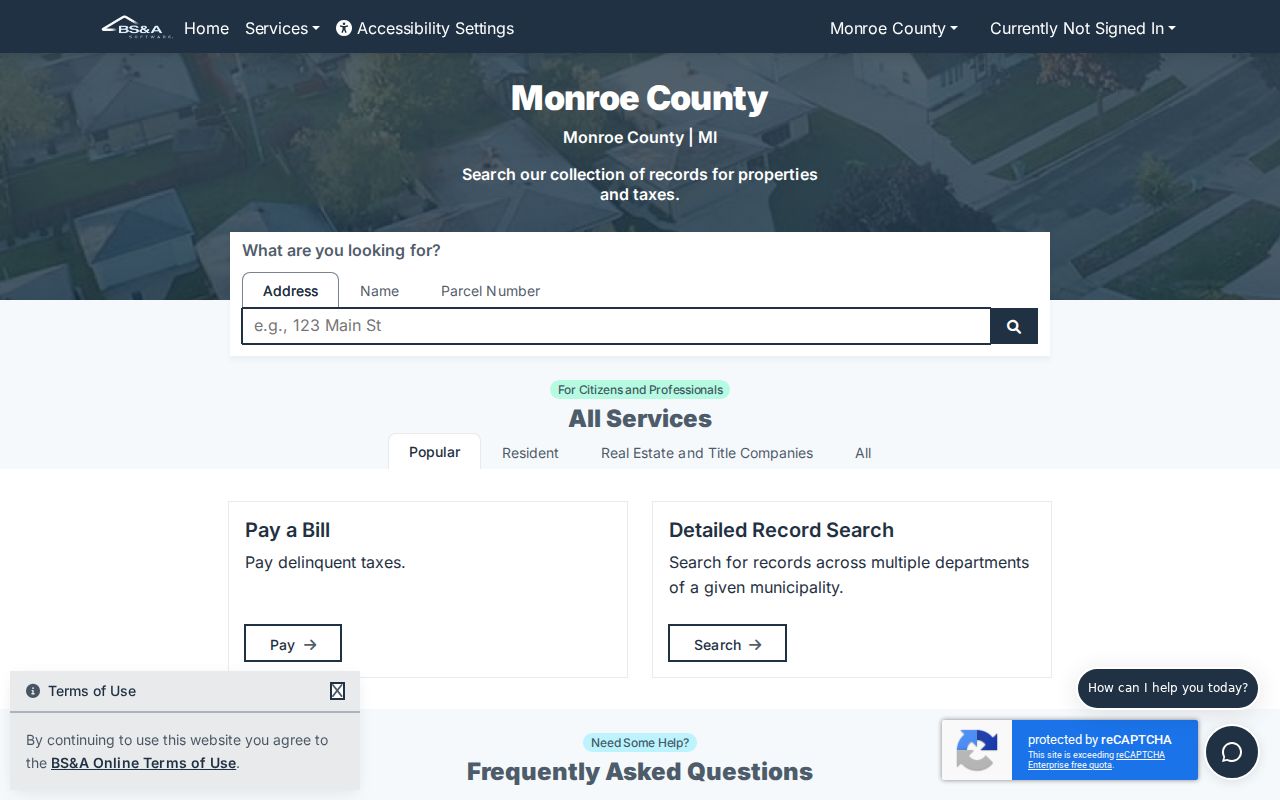
That screen is a starting point for a parcel trail. It should be paired with a record date and, where needed, the deed index or a clerk confirmation.
Monroe GIS Checks Local Geography
The Monroe County Parcel Viewer provides a map layer for parcels, municipal boundaries, ZIP codes, centerlines, roads, buildings, water, parks, and other geographic context. Zoom to the street, turn on parcel and centerline information, and record the parcel ID and legal description before comparing nearby property records. The county describes the assessment information as updated biannually and the map as a browsing tool, not a legal boundary survey.
Monroe has a useful geography warning. ZIP codes 48161 and 48162 each serve portions of the city and surrounding townships. A Monroe mailing line or ZIP alone does not establish City of Monroe jurisdiction. Verify the municipality layer, the parcel jurisdiction, and the legal description. That small check prevents a postal address from being mistaken for a city record boundary.
- Parcel
- An assessment and map identifier for a defined piece of land.
- Situs address
- The physical location used for assessment, maps, permits, and local jurisdiction.
- Mailing address
- The tax or owner correspondence destination, which may not be where the parcel sits.
- Legal description
- The lot, block, subdivision, claim, or metes-and-bounds land description used in recorded instruments.
Monroe Deed Searches Need Names
Monroe County's practical deed sequence is address to parcel, parcel to owner and legal description, then owner name to the party index. County guidance says staff cannot search ownership by street address. The free Fidlar Direct Search application has Party Name, date, document number, document type, Book, Page, reference-number, Address, Subdivision, Parcel, Municipality, and Tract options. Use those fields as index tools, then verify the matching instrument through its legal description and party roles.
The county says its online name index begins January 1, 1981. It describes Laredo remote or in-house access from 1976. Those dates do not promise a free image for every instrument. Older books and indexes are held through county and historical repositories. For a difficult old parcel, use the clerk counter, MCLS, the Library of Michigan, Archives of Michigan, or the developing museum-preservation route instead of taking a web blank as proof that no deed exists.
Note: A grantor is the party transferring an interest, while a grantee is the party receiving it; each name is a lead for the next earlier instrument.
Current Monroe Resident Sources
There is no single current Monroe residents directory. The sources below answer narrower questions. Their differences are helpful: a parcel roll is about an owner or taxpayer, a deed index is about parties to recorded instruments, and an election record is about registration. Use the record that matches the question, then confirm with a second independent detail when identity matters.
| Monroe source | Person or connection shown | Custodian | Access path |
|---|---|---|---|
| BS&A parcel and tax record | Assessed owner or taxpayer, parcel, situs and mailing context | City Assessor/local unit | Public basic search |
| Fidlar deed index | Grantors, grantees, instrument and recording details | Clerk/Register of Deeds | Free index with separate image or remote-access terms |
| MVIC and QVF route | Voter registration information subject to redaction | Michigan elections offices | Individual voter route or lawful public-record request |
| MiCOURT case index | Public case party, number, status, and disposition data | Michigan courts/local clerk | Informational public search, then custodian file process |
| City service directory | Correct municipal department or records custodian | City of Monroe | Public service-directory route |
A name-first question can move from the parcel roll to court, vital, or historical sources, but the roles should not be collapsed. A focused Monroe resident lookup keeps those checks centered on one person.
Monroe Voter Records Have Limits
Michigan Voter Information Center is an individual voter-information route for registration, polling-place, ballot, and clerk information. It is not a street roster. The full Qualified Voter File uses a separate public-record request form with geography choices such as county, jurisdiction, district, school, village, or ward and precinct. The form is the appropriate route for a lawful, specifically described data request, not an informal demand for a household list.
Public registration records have limits. Michigan withholds driver-license and state-ID numbers, month and day of birth, phone, email, receiving-office information, refusal-to-register records, digital signatures, and other sensitive fields. Michigan does not ordinarily register voters by party, and ordinary registration data does not disclose ballot choices. A registration result is evidence of an election record, not proof of every person living at an address.
The MVIC entry screen is the individual information route described by the state.
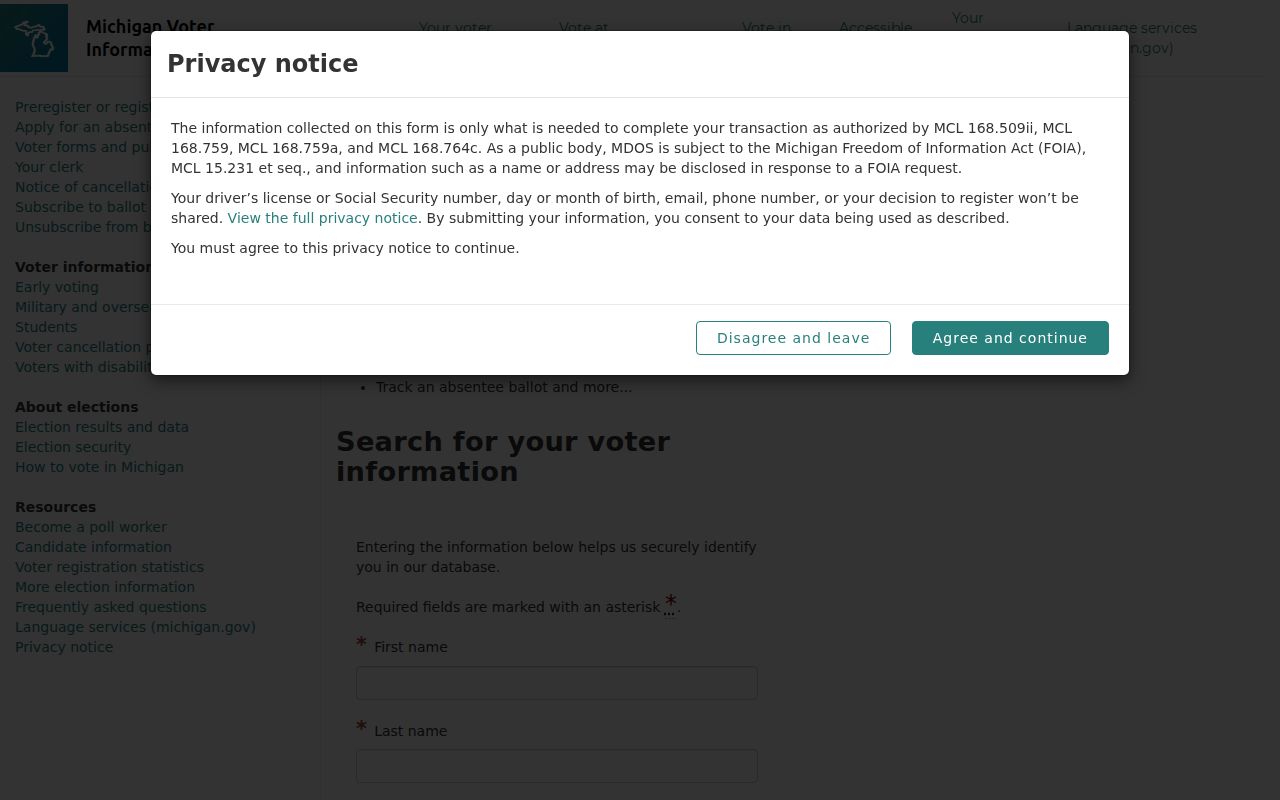
Use that channel for its stated election purpose, then ask the Monroe Clerk-Treasurer or Bureau of Elections about a formal records request.
Monroe Court Names Need Checking
MiCOURT offers a statewide public case-search route. Its documented party-name controls include last or business name, optional first and middle name, and birth year. A separate case-number panel uses year, number, and type. Results can provide a useful lead, but the statewide index is informational rather than the official court file. Match the court, case number, party role, filing date, category, status, and disposition before attaching a result to a Monroe resident.
Some records are not displayed. The public search excludes or limits many juvenile, adoption, guardianship, name-change, mental-health, protective, and other confidential matters. A statewide notice also limits some criminal displays to cases with sentences within seven years. For the file or a certified copy, use the relevant Monroe court clerk or Probate public-access route. A same-name result should never be treated as proof by itself.
Monroe Vital Records Set Gates
For a life-event question, the Monroe County Clerk and Michigan Department of Health and Human Services use different channels from the property and court systems. The county genealogy page identifies local index paths for deaths from 1867, marriages from 1818, and births from 1874. State registration begins in 1867 for births, deaths, and marriages, and in 1897 for divorces. Local materials, church records, newspapers, and archives can help before those civil dates.
Michigan birth records have a privacy threshold. State law opens birth copies to anyone after 100 years, while the county genealogy page describes a 110-year local practice, so confirm the county handling before relying on the exception. Death, marriage, and divorce copy access is broader, subject to the right form and fee. A verification gives selected event facts; it is not the same thing as a certified copy. The state order page lists mail, online, phone, dropbox, appointment, and will-call methods.
The Michigan vital-record order page sets the current ordering methods, identity requirements, fees, and processing information.
Older Monroe Directory Shelves
Historical directories place a Monroe household at a particular place and year between census dates. The established local evidence includes a GSMC-linked 1860 Monroe directory, the 1861-62 Lake Shore Gazetteer, a 1916 directory, and cataloged 1946, 1948, 1950, 1952-1954, 1956, and 1958-1960 runs. Exact format and availability can vary by volume. Check with MCLS, GSMC, the Library of Michigan, or a library-access database before assuming that a title is online.
A typical city-directory entry can show a household head, street address, occupation, business listing, spouse or widow notation, and sometimes owner or renter marks. Street pages may be alphabetized and arranged by house number. A criss-cross directory is an address-ordered index when a person is unknown. The full collections, shelf routes, and tracing method belong on the Monroe city directories page.
Monroe Notices Add Family Context
Monroe-area newspapers can add a date, address, relationship, school, church, business, or civic detail to a directory entry. The digitized archive lists the Monroe Evening News for 1918-1945 and other local titles reaching from the 1830s into later decades. Search a surname and address variant, then read the actual page because OCR can miss or misread names. The county-linked obituary route is a useful lead for a death notice, relatives, or funeral information, not a substitute for a certified record.
GSMC adds church records, yearbooks, cemetery work, maps, and the Betty Gay Collection. Its materials describe more than 95,100 burials and more than 5,000 names across 35 binders, but collection listings do not mean every item is online. The society says its archive is closed during construction, with Wednesday assistance at Ellis Library noted by the society. Verify the current notice before travel.
Monroe Preservation Is Not Online
Monroe County's recent preservation materials explain why older records may exist without appearing in a search box. County board material described a 2025-2026 preservation quote for 121 books and an estimated 64,534 pages, including deed indexes, deed books, and vital and military volumes. A separate museum agreement describes controlled custody and supervised research access for selected historical property records. Those documents show preservation work and a research route, not a promise that the books are already digitized.
For pre-digital research, use the keeper that holds the actual series. The Library of Michigan guide lists Deed Books A, B, and C from 1806-1818, naturalization material, cemetery-history records, maps, and newspapers. Archives of Michigan lists county court, probate, tax, voter, and rural-property record groups. A narrow request with a name, address, parcel, record type, and year range gives staff a usable starting point.
Monroe Specialty Tools Stay Narrow
Specialized state and county tools can answer narrow questions but do not create a general Monroe residents directory. The jail lookup and the state custody tools concern custody status. The public offender registry has its own legal purpose and search modes. Professional licensing and business-entity records can show a public affiliation, license status, registered agent, or office, but an office record is not automatically a current home address. Keep each result attached to the role it actually documents.
The Monroe County inmate lookup points users to the county custody route and related notifications.
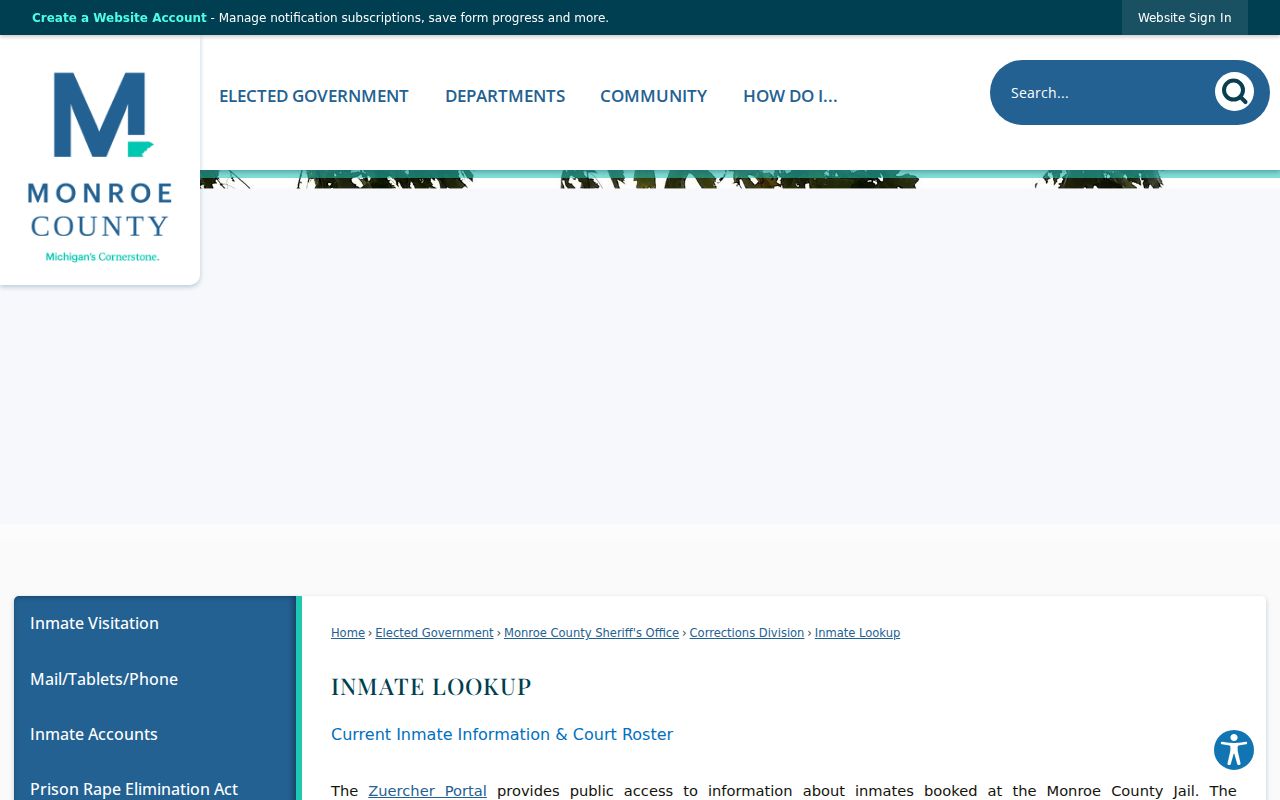
Custody information is time-limited and should never be used as a substitute for an address or identity record.
The Michigan public offender registry offers name, city, county, ZIP, address-radius, and map or list modes within its published scope.
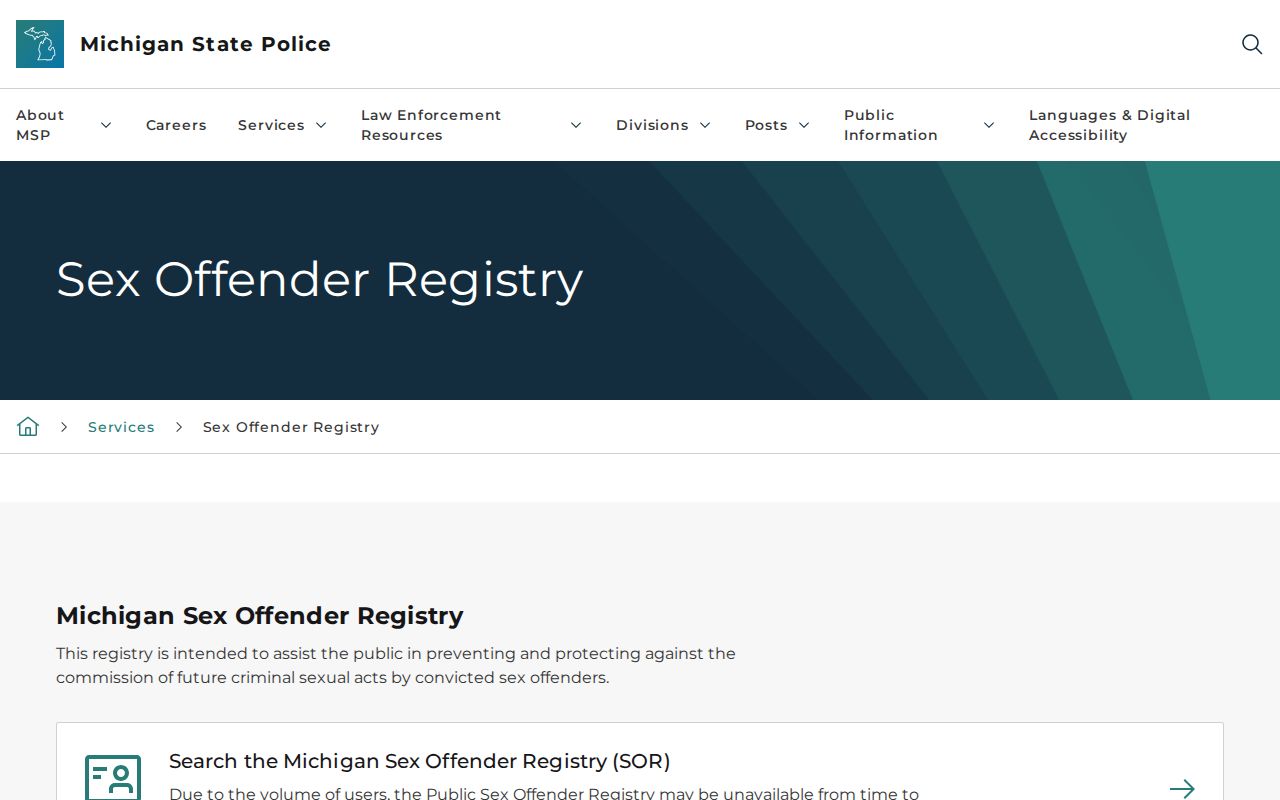
Registry publication rules and status limits still apply, so a result or a blank result is not a broad claim about someone’s residence or record history.
The Michigan MiPLUS licensing route is the public starting point for a profession-specific status search.
Use a license record to verify the public professional record it displays, and compare it with a dated Monroe source before drawing an identity conclusion.